Eid Milad un Nabi 2026 in the UK: Date, Julus Routes, Ijtimas & Mehfil-e-Naat Near You
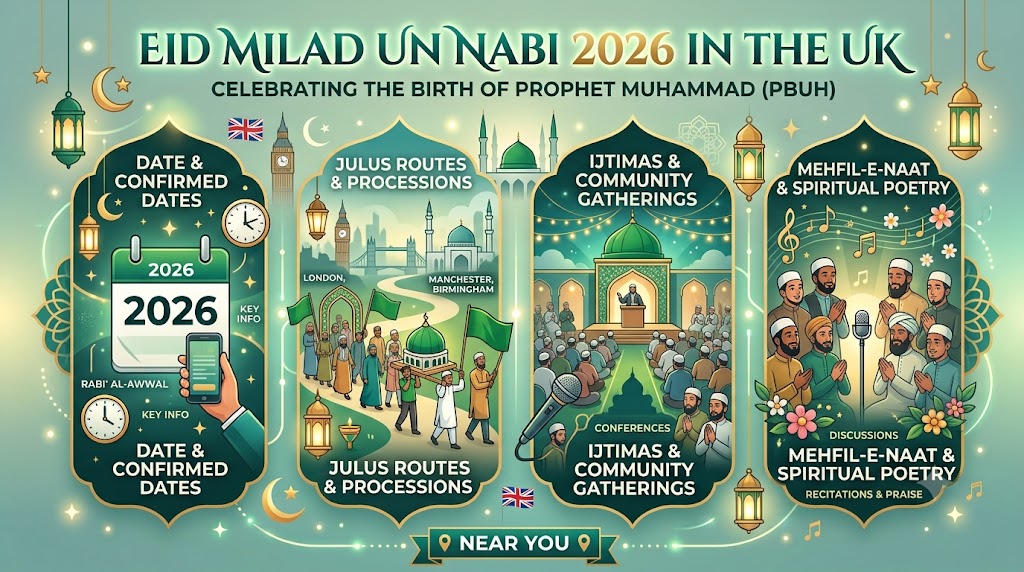
Eid Milad un Nabi 2026 falls on Monday 24 August in most of the UK, with a good number of mosques observing it on Tuesday 25 August. Rabi ul Awwal 1448 is expected to begin on or around 14 August, subject to the moon being sighted. As always, your local masjid has the final word.
That's the short answer. Now the part nobody writes down properly.
Because if you've ever tried to find out what's actually happening near you in Rabi ul Awwal, you'll know the routine. Somebody's cousin forwards a WhatsApp flyer with no year on it. There's a poster in the masjid lobby you only notice on the way out. Half the events you hear about are the day after they happened. Meanwhile the biggest julus in your city goes past the end of your road and you find out from Facebook on Monday morning.
So this is a practical guide. Dates, how the processions work, what a mehfil is actually like if you've never sat in one, and how to find the ones happening near you this year.
When is Eid Milad un Nabi 2026 in the UK?
Date1 Rabi ul Awwal 1448Friday 14 August 2026 (expected)12 Rabi ul Awwal 1448Monday 24 August 2026Observed by many UK mosquesTuesday 25 August 2026End of Rabi ul Awwal11 September 2026
The one-day gap is normal and it isn't a mistake. UK mosques follow different sighting authorities, some local, some tied to Makkah, some to the subcontinent. Every year a portion of the community marks the 12th on one day and the rest on the next. It has never been worth falling out over, and it usually just means the barakah stretches across two evenings instead of one.
Here's the thing worth planning around, though. 24 August 2026 is a Monday. Which means almost every large public procession in the country will move to a weekend.
Look at the two candidate dates:
Sunday 23 August — the Sunday immediately before the 12th
Sunday 30 August — the Sunday after, and the day before the late August bank holiday on Monday 31 August
My money is on 30 August for the big ones. A bank holiday Monday gives families a recovery day, the schools haven't gone back yet, and organisers get a clear run at road closures without a Monday morning commute to argue with. If you're planning to travel to a julus this year, keep both Sundays free until the flyers land in mid-August.
Julus processions: how they actually work
A julus (jaloos, or milad procession) is a walk. Sometimes a mile, sometimes three. It sets off from a masjid or a park, moves through the local streets, and comes back. Banners, green flags, Salaam and durood on a PA system mounted to a van, kids on shoulders, and at some point somebody hands you a rose or a laddu whether you asked for one or not.
The long-running ones tend to be organised by the same institutions year after year. Bradford Grand Mosque has run its procession for decades, setting off from the Horton Park Avenue area. Darul Uloom Qadria Jilania in Birmingham runs one that regularly gets billed as the largest in the UK and Europe. Manchester, Rochdale, Leicester, Glasgow, Luton and East London all have their own, and dozens of smaller towns run neighbourhood versions that never make it past a local Facebook group.
I'm not going to publish 2026 route maps here, because they don't exist yet and I'd rather not have you standing on the wrong street corner. Routes need council sign-off and road closure notices, and most organisers only confirm them a week or two before. Anyone publishing a "confirmed 2026 route" in July has copied it from last year.
What you can do is watch for them. Local council road closure notices go up on the council website roughly 10-14 days before. Masjid WhatsApp broadcast lists usually go out a fortnight ahead. And events posted on Gather Ummah get updated as organisers confirm details, so it's worth checking your city page in the second week of August rather than the first.
If it's your first julus
A few things that would have saved me some hassle the first time:
Arrive 45 minutes before the advertised start. Not because it'll start on time — it won't — but because the parking within half a mile evaporates. Park further out deliberately and walk in. Residential streets around the setting-off point get blocked, and you do not want to be the car that a thousand people have to walk around.
Late August in Britain means take a coat regardless of what the forecast says. You'll be outdoors for two to three hours, walking slowly, which is colder than it sounds.
Bring water, especially with children. The langar and degh usually happens at the end, not the start, and it can be a long wait for a small child who was promised food.
If someone in your family uses a wheelchair, message the organisers beforehand. Most processions have a slower group at the back and a couple of stewards who'll walk with you, but that's arranged informally and you have to ask.
And expect the hi-vis stewards to be volunteers giving up their Sunday. Listening to them the first time they ask is a small sunnah of its own.
Mehfil-e-Naat and milad ijtimas: what to expect
The processions get the photos. The mehfils are where most of the month actually happens.
A mehfil-e-naat is a gathering built around naat — poetry in praise of the Prophet ﷺ, recited or sung, usually without instruments in this tradition. A milad ijtima is broader: naat, a bayan or two, collective durood and Salaam, dua, and food afterwards. Some run for ninety minutes. Some run past midnight and nobody minds.
Through Rabi ul Awwal you'll find them in three places. In masjids, most commonly on a Friday or Saturday evening. In community halls, when the crowd outgrows the masjid. And in people's houses — the ghar ka milad, thirty or forty people in a living room with the sofas pushed against the wall, which is honestly where the atmosphere is at its best.
If you've never been to one:
You don't need to know Urdu. A good chunk of the naat will be in Urdu, Punjabi or Arabic and you will not follow all of it. Most gatherings now have at least one English bayan, and increasingly there are English-language mehfils aimed at younger attendees. Go anyway. The parts you don't understand still do something.
Dress modestly, sit where you're pointed, keep your phone quiet. When Salaam is recited near the end, everyone stands. Stand with them.
Bring the kids. Children run about at these things. Nobody expects silence from a four-year-old, and the memory of the lights and the food and the atmosphere is doing more for them than a lecture would.
Take something. A tray of sweets, a bag of fruit, a contribution towards the degh. Turning up empty-handed is fine, but nobody has ever regretted turning up with mithai.
Beyond the events: what this month is for
It's worth saying plainly, because a month can pass in flyers and food and be over before you've done anything with it.
Rabi ul Awwal is the month of the Prophet's ﷺ birth, and by most accounts his passing. The classical response to it has been to increase in three things: durood, learning about his life, and following him in something specific.
Durood is the easy one to start and the easy one to drop. Pick a number you'll actually keep for 30 days rather than a number that sounds impressive on day one. Three hundred a day that you maintain beats three thousand you abandon on the fourth.
Learning about his life — pick one seerah book and finish it this month. Martin Lings' Muhammad: His Life Based on the Earliest Sources is the one most people manage to get through in English. Read fifteen pages a night and you'll be done before the month ends.
And one sunnah. Just one, chosen because it's the one you don't do. Eating with the right hand. Not sleeping angry with someone. Smiling at people you don't know. Small, specific, kept after September.
There's also a strong custom in this month of feeding people, and it doesn't have to stop at the community. Late August is a genuinely difficult time for foodbanks in the UK, sitting right at the end of the school holidays when free school meals have been off for six weeks. A degh at the mehfil and a shop for the local foodbank in the same week is very much in keeping with the point of the month.
A note on differences
Some UK Muslims mark Rabi ul Awwal with processions and mehfils. Some observe the month quietly with durood and seerah and don't hold gatherings at all. Both positions have scholarship behind them and both are held by people who love the Prophet ﷺ.
This guide is written for people who are looking for events, because that's what this site does. If that's not your practice, no argument from us. Adab in disagreement is itself part of what we're all supposed to have learned from him ﷺ.
For organisers: get your event found
If you're running a mehfil, ijtima or julus this Rabi ul Awwal, the hardest part isn't the programme. It's that people who would have come never heard about it.
A few things that make a measurable difference:
Announce four weeks out, not one. Late August is holiday season. Families book things. A flyer on 20 August is competing with plans made in June.
Put the year on the poster. Enormous number of milad flyers circulate with no year on them, get re-shared in 2027, and send people to an empty car park.
Include the postcode, the start time and whether there's parking. In that order. Those are the three things every person asks before deciding.
Get it off WhatsApp. WhatsApp reaches the people who already know you. It does nothing for the family who moved to the area in March and doesn't know your masjid exists. Listing it somewhere searchable is how you reach them.
You can list a Rabi ul Awwal event on Gather Ummah for free — it takes about two minutes, and it puts your programme in front of people searching for exactly this. There's no charge and there never will be for community events.
FAQ
When is Eid Milad un Nabi 2026 in the UK? Monday 24 August 2026, with many UK mosques observing it on Tuesday 25 August. It depends on the sighting of the Rabi ul Awwal moon around 12-13 August.
Is Eid Milad un Nabi a public holiday in the UK? No. It isn't a bank holiday. Most workplaces will grant leave on request, and schools are on summer holidays in late August anyway, which is why family turnout tends to be high in years like this one.
What's the difference between a julus and a mehfil? A julus is a public procession through the streets. A mehfil (or ijtima) is a seated gathering, usually indoors, built around naat, bayan and dua. Many organisers run both on the same day, with the mehfil following the procession.
Do women and children attend? Yes, at the vast majority of events. Larger mehfils have separate seating for sisters, and many masjids run a dedicated sisters' programme during Rabi ul Awwal. Processions are generally family events. If you want to check the arrangements at a specific gathering, the organiser's number is usually on the flyer.
How do I find events near me? Browse by city on Gather Ummah — new Rabi ul Awwal events go up through August as organisers confirm them. Our WhatsApp channel posts weekly listings if you'd rather have them come to you.
Dates on this page are based on expected moon sighting and will be updated once Rabi ul Awwal 1448 is confirmed. If you spot an error or you're organising something that should be listed here, tell us.