How to Organise a Mehfil-e-Naat That People Actually Attend
The difference between a mehfil-e-naat with eight hundred people and one with fifteen is almost never the reciter — it's whether anyone outside the committee's own circle knew it existed. A practical guide for Rabi al-Awwal organisers.
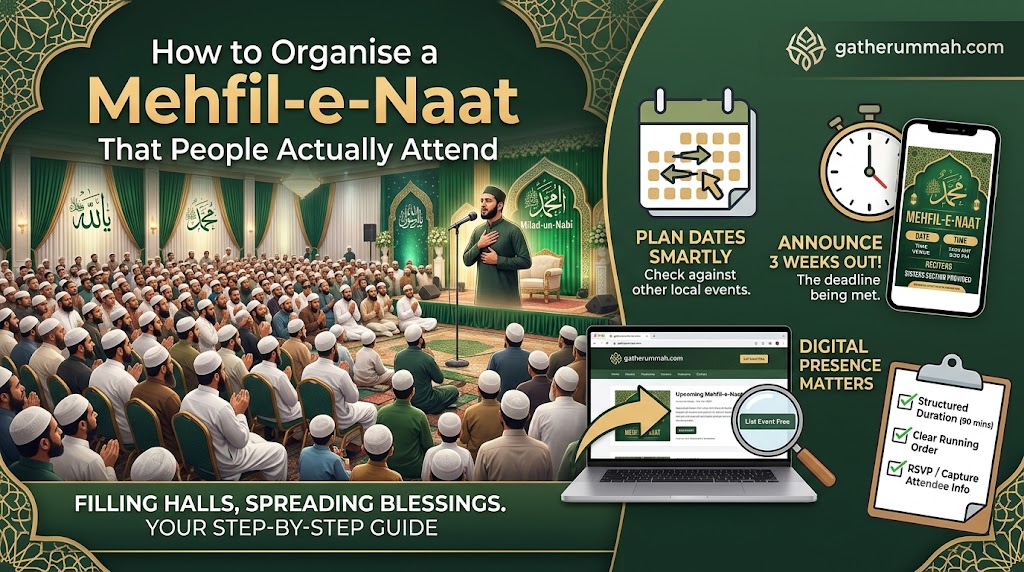
I've sat in mehfils where the naat khwan's voice filled a hall of eight hundred people, and I've sat in mehfils where fifteen of us rattled around a room set up for two hundred.
Here's the uncomfortable truth: the fifteen-person mehfil often had the better reciter.
Attendance was never about quality. It was about whether anyone outside the organising committee's own circle knew the event existed. With Rabi al-Awwal starting around 14 August, hundreds of UK committees are planning mehfil-e-naat programmes right now — so, from someone who has helped organise them and attended more than he can count, here is what separates a full hall from an empty one.
1. Pick your date against the calendar, not around it
The 2026 season concentrates on three points: the weekend of 15–16 August (the month's opening), Sunday 23 August, and the bank holiday weekend of 29–31 August. Eid Milad un Nabi itself is Tuesday 25 August for most UK calendars.
Going head-to-head with your city's grand mawlid on the same Sunday afternoon is how you get fifteen people. Check what's already listed in your city before you book the hall — either claim a quiet evening, or run your programme as a warm-up or follow-on to the big one rather than against it.
2. Announce it three weeks out, not three days
The standard timeline — poster finished Monday, event on Saturday — guarantees your only audience is people already coming to the masjid that week. Families plan weekends further ahead than we admit, especially in the school holidays.
Three weeks out: date, venue, and headline reciter announced. Two weeks out: poster in circulation and the event listed where people search. Final week: reminders. The events that fill halls — like Bolton's Grand Mawlid, now in its 32nd year — are announced well over a month in advance.
3. Put it where people actually look
Your poster in the family WhatsApp group reaches the people who were already coming. It does not reach the family two postcodes away typing "mehfil e naat near me" into Google — and people genuinely do.
That's a two-minute fix: list the event free on Gather Ummah — you can upload the poster you already made and the form fills itself in. Your mehfil then appears on your city's events page, the Rabi al-Awwal hub, and in search results, with a link people can forward that doesn't die in a group chat. The longer argument for why this matters is here.
4. Decide who the mehfil is for — then say so
"All welcome" on a poster tells a family nothing. Is there a sisters' section? Is it seated on the floor or on chairs? Will it finish by 10pm on a school night? Can they bring a seven-year-old?
The programmes that get families through the door answer these questions on the poster and in the listing. Oldham's welcome-the-month mehfil with Owais Raza Qadri works because everyone knows exactly what they're getting: the reciter, the time, the place.
5. Structure beats stamina
A mehfil that runs "until late" loses families at the planning stage — they never come, because they can't commit to open-ended. Ninety minutes to two hours, a printed running order, salawat the audience can join, one short talk at most, and food at the end (announced in advance — it changes attendance, let's be honest).
6. Capture the room you filled
The night went beautifully — and next year you'll start from zero again, unless you do one thing: give people a way to hear from you next time. A listing with RSVPs does this automatically; attendees who opt in can be emailed about your next programme. Your December mehfil starts with an audience instead of a cold start.
The point of all of it
None of this is marketing for its own sake. Someone in your city wants to spend an evening of this month in praise of the Prophet ﷺ and doesn't know your event exists. Every fix above is just closing that gap.
Plan the programme with ihsan, announce it like you mean it, and put it where people are looking. The hall fills.