Thirty Days of Seerah: A Reading and Salawat Plan for Rabi al-Awwal
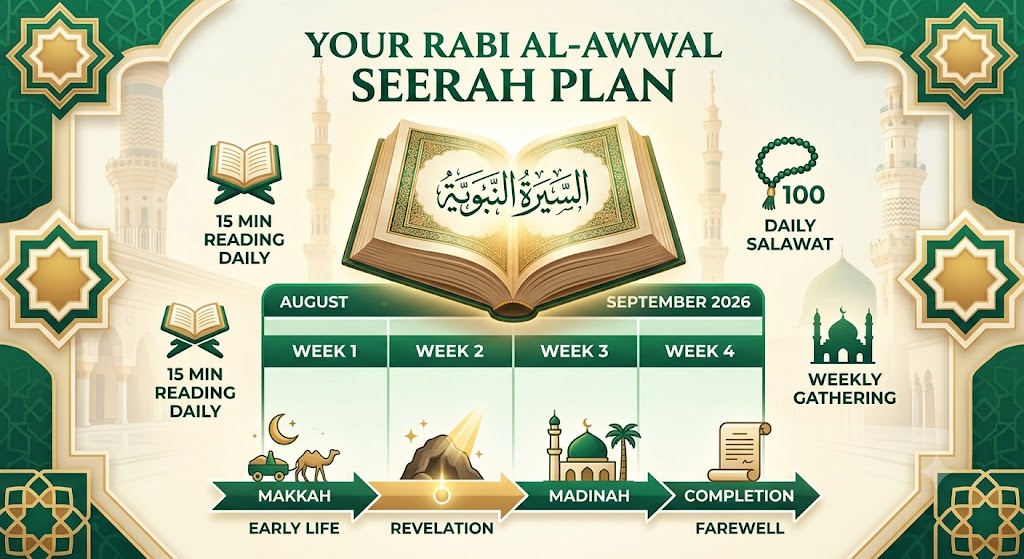
Fifteen minutes of seerah a day, a salawat count you can sustain, and one gathering a week — a four-week plan that follows the Prophet's ﷺ life in order across Rabi al-Awwal 2026, from 13 August to 11 September.
Ask me anything about my phone's battery habits and I can tell you in detail. Ask me to narrate my Prophet's ﷺ life from Makkah to Madinah without gaps, and I'll manage the famous scenes and go quiet in between.
That gap bothered me enough that last year I did something about it: I treated Rabi al-Awwal the way we treat Ramadan — as a month with a plan. Not an ambitious one. Fifteen minutes a day and a salawat count. It was the first time the month changed me instead of passing me.
Rabi al-Awwal 1448 begins around 13–14 August 2026 and runs to about 11 September. Here's the plan, cleaned up and ready to steal.
How it works
- Reading: 15 minutes of seerah a day, in four weekly arcs that follow the Prophet's ﷺ life in order. Any sound seerah book works — Ar-Raheeq al-Makhtum, When the Moon Split, Muhammad: His Life Based on the Earliest Sources — or your teacher's recommendation.
- Salawat: a daily count you can actually sustain. 100 a day is five minutes. Set it, track it, don't negotiate with it.
- Gathering: attend one thing each week if you can — a talk, a mehfil, a mawlid. The month is communal; the reading is just the spine. Here's what's on near you.
Week one (13–19 August): before the light
Arabia before the message; the year of the elephant; birth and childhood; the years as a shepherd and a trader; the marriage to Khadijah رضي الله عنها; the man known as al-Amin before a single verse was revealed. Read this week slowly — the character precedes the prophethood, and that ordering is the lesson.
This week is also when the UK's opening programmes land, like Marhaba Ya Mustafa in Oldham on 15 August. If you want a structured start, Birmingham's Mawlid Essentials course begins just before the month does.
Week two (20–26 August): revelation and resistance
The cave; the first revelation; the trembling walk home to Khadijah; the earliest believers; the mockery, the boycott, the Year of Sorrow; Ta'if — and the answer to Ta'if, the night journey. The hardest week of the story, deliberately falling across 12 Rabi al-Awwal itself — Tuesday 25 August (some UK communities observe the 24th; your masjid has the final word).
This is the week of the season's biggest gatherings, including Bolton's 32nd Annual International Grand Mawlid and its Sisters Grand Mawlid on Sunday 23 August. Go to one. Reading about him ﷺ alone is good; loving him in a room full of people doing the same is something else.
Week three (27 August – 2 September): the city he built
Hijrah; the brotherhood between Muhajirun and Ansar; the constitution of Madinah; the masjid at the centre of everything; Badr and Uhud and what each taught. Read this week asking one question: what did he ﷺ actually build, and how? The bank holiday weekend (29–31 August) carries the season's last big programmes — check what's still on.
Week four (3–11 September): the completion
The treaty that looked like defeat and wasn't; the return to Makkah and the general amnesty; the farewell sermon; the final days. Finish with the farewell sermon read in full, out loud, at home. It takes four minutes and lands differently in your own voice.
Keeping it after the month ends
Salawat doesn't have a season. Whatever your daily count was, keep half of it going forward — the point of a thirty-day plan is the habit that survives it. And put the Islamic calendar somewhere you'll see it, so next Rabi al-Awwal doesn't catch you out the way it used to catch me.
Share the plan with whoever needs it. It's free, it's fifteen minutes a day, and it's his ﷺ month.